
THIS IS WHERE THE MAGIC HAPPENS.
Insightful tips, in-depth guides, and essential resources to help you streamline your business operations and enhance efficiency, so you can focus on what truly matters!
THIS IS WHERE THE MAGIC HAPPENS.
Insightful tips, in-depth guides, and essential resources to help you streamline your business operations and enhance efficiency, so you can focus on what truly matters!
Stay Connected and Simplify Your Business!
Sign up to be on our blog/newsletter list and get easy tips, tools, and strategies to help your business grow—delivered straight to your inbox.
Join today and start making business easier!
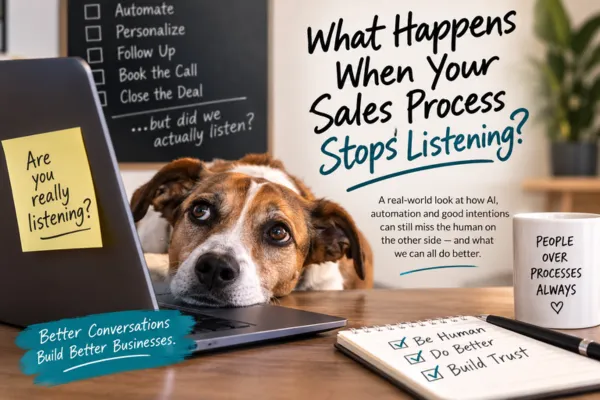
What Happens When Your Sales Process Stops Listening?
What Happens When Your Sales Process Stops Listening?
Like most business owners, I get a ridiculous number of emails from random companies promising to bring me more clients. Most of them get deleted without much thought, but recently I decided to respond to one.
Part of this was curiosity and, if I'm being completely transparent, part of it was because I was feeling a little feisty that day.
But there was also something legitimate behind it. I actually AM interested in finding a company that can help me with outbound sales. So instead of immediately dismissing another big promise landing in my inbox, I decided to see what would happen if I qualified them as carefully as they were undoubtedly going to qualify me.
I gave them three non-negotiables.
I wasn't asking them to work for free. I wasn't asking them to agree to every detail before we'd even spoken. But these were the conditions that would have to be true for me to consider doing business with them, and I wasn't willing to bend on them.
If they could say yes, great. Let's have a conversation.
If they couldn't, also great. Let's not waste anyone's time.
I thought that was pretty straightforward.
Apparently, it wasn't.
And then things got interesting
Instead of answering my questions, they kept trying to move me through their sales process. The more I tried to clarify that I needed those three things confirmed before agreeing to a conversation, the less relevant the responses became.
At some point, I realized I wasn't really evaluating their offer anymore. I was evaluating them.
Because here's the thing: they were trying to sell me an outbound sales service while I was actively experiencing their outbound sales service.
What better test could there possibly be?
So I kept going.
I wasn't trying to trick them. In fact, I was doing the opposite. I was practically handing them the roadmap. I was an engaged prospect telling them exactly what mattered to me, exactly what my objections were and exactly what they needed to answer if they wanted to move me forward.
Remember, qualification works both ways. They were deciding whether I was a potential client for them, but I was deciding whether they were a potential vendor for me.
And they weren't hearing me.
The process just kept processing.
Eventually, I had a meeting on my calendar that I never agreed to. By the time the day came, I had pretty much lost interest and almost didn't go. Then the reminder popped up and I thought, what the hell, I've come this far. Let's finish the experiment.
So I got on the call.
Before the poor guy had an opportunity to launch into whatever sales presentation he had prepared, I hijacked his meeting.
I shared my screen and walked him through my experience as their prospect. I showed him where I had tried to engage, where I had asked questions, where the answers stopped matching what I was actually saying and where their systems continued doing exactly what they were designed to do while completely missing the human being on the other side.
And to his credit, he listened.
That conversation ended up being the most valuable part of this whole exercise.
At some point I learned that he was also a marketing consultant, so I asked him how much time he spends overcoming the damage done by marketers who came before him.
His answer was basically: a lot.
And I remember thinking, THIS. This is exactly why I need to share this story.
Somebody has to clean up the mess
I've known this problem for a long time because I've experienced it in my own business. Someone hires a marketing company because they need help. They hand over their money, but they're also handing over something much more valuable: trust.
They're trusting this company to represent their business. They're trusting them with their brand. They're trusting them to talk to potential customers on their behalf. And usually they're doing it because they genuinely need something to change.
Then someone makes a bunch of promises and doesn't deliver.
What happens next?
That business owner doesn't just lose the money. They learn not to trust the next marketing company.
And eventually another marketing company, consultant or salesperson comes along who may be perfectly capable of helping them. Except now that person isn't starting at neutral. They're starting with a trust deficit they didn't create.
Before they can even demonstrate what they can do, they have to overcome the skepticism, hesitation and sometimes outright fear created by the last person who said, “Trust me, this will work.”
And while I was walking this salesperson through the experience I'd just had with his own company, I realized we were looking at both sides of that problem at the same time. He was telling me how often he has to rebuild trust after another marketer has broken it, while I was showing him how his own company's sales process was creating exactly that kind of distrust with me.
And this isn't just marketing.
Hire a contractor after you've had one disappear halfway through a home renovation and tell me you don't approach the next one differently.
Hire a coach after you've spent thousands of dollars on someone who promised an outcome they couldn't possibly guarantee.
Hire a bookkeeper after you've discovered the last one screwed up your books.
We carry those experiences forward.
Which means every time one of us overpromises and underdelivers, we don't just make our own job harder. We make the job harder for every good business owner who comes after us.
That bothers me.
But there was another lesson in this for me
During our conversation, he explained that the system his company uses internally isn't really the same system they provide to their clients. Their clients get more people involved and a different level of service.
And I stopped him.
I basically said, I want you to actually listen to what you're saying. You're selling a service that you aren't using yourselves. You're using a less effective version of it.
He stopped for a second and said something like, “Hmm. That's a good point.”
And I give him a ton of credit for that.
Because he could have gotten defensive. He could have spent the rest of the call trying to convince me that I misunderstood what had happened. Instead, he listened.
And it made me ask a question that I think all of us should probably ask ourselves:
When was the last time you actually experienced your own business as a customer?
Not when was the last time you looked at your workflow or somebody on your team told you everything was working. When was the last time you actually went through it?
Because I own an automation company. I LOVE automation. And if you've spent more than five minutes with me lately, you also know I LOVE AI. I use both every single day (even to help me write this post).
And here's what was fascinating about this experience: the automation didn't really fail.
The automation did exactly what it had been told to do. It moved me along. It scheduled things. It followed up. It kept the process going.
The AI was the part that wasn't accurately understanding what I was saying. It made assumptions, created personalization based on those assumptions and continued feeding information into a sales process that became further and further removed from the actual conversation I was trying to have.
But even that isn't entirely an AI problem.
Where was the point in the automation that said, Hey, something isn't going according to plan here. A human might need to look at this?
That's the piece we can't forget as we get more excited about what AI and automation can do for us.
They should help us pay more attention to people, not give us permission to pay less.
If the technology is doing exactly what we told it to do while the customer is getting increasingly frustrated, I don't consider that a successful automation.
I consider that a really efficient way to lose a customer.
So here's my challenge for you
Go mystery shop your own business.
Actually do it.
Fill out your own form. Book yourself on your calendar. Read the confirmation emails. Reply to something. Ask a question. Look at what happens when someone does something your automation wasn't expecting them to do.
Then go a little deeper. Look at the promises you're making in your marketing and compare them to what happens after someone buys. Ask yourself whether your sales team is incentivized to make the right sale or simply make the sale. Look at the handoff between sales and delivery. Does the person responsible for fulfilling the promise actually know what was promised?
And if you're using AI and automation, don't just test whether they work when everything goes exactly according to plan.
Test what happens when a human doesn't follow the plan.
What happens when they reply with a question?
What happens when they object?
What happens when the AI gets something wrong?
What happens when someone needs an actual person?
And maybe most importantly, pay attention to the places where your customers and prospects are trying to tell you something.
Because the biggest lesson I took from my ridiculous little cold-email experiment wasn't that AI is bad, automation is bad or salespeople are bad.
It was about listening.
I said something to the guy I met with that I haven't been able to stop thinking about since:
For all of us who own businesses or are responsible for sales, may we never get so far removed from our own sales process that we don't recognize when a prospect is crying out to be heard.
Because I was.
And here's the thing. I stopped. I took the meeting. I showed him what happened. I gave him the feedback. I genuinely hope they use it to get better.
The next person may not be so gracious.
They'll just leave.
And you may never know why.

Menu




© Copyright 2026. All rights reserved.